|
MOM6
|


|
|
MOM6
|
|
Horizontal diffusion of tracers
Lateral mixing due to mesoscale eddies is believed to occur according to this figure:
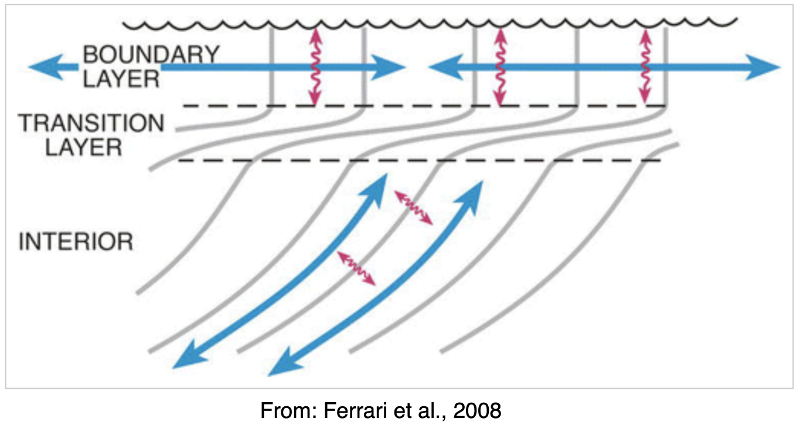
For the interior of the ocean, we would like to have horizontal diffusion with the following properties:
The algorithm used in MOM6 is described by [31] and will be introduced here. The aim is to allow lateral mixing of tracers within isopycnal layers. It is appropriate for the adiabatic interior of the ocean while a lateral mixing scheme for the surface boundary layer is described below.
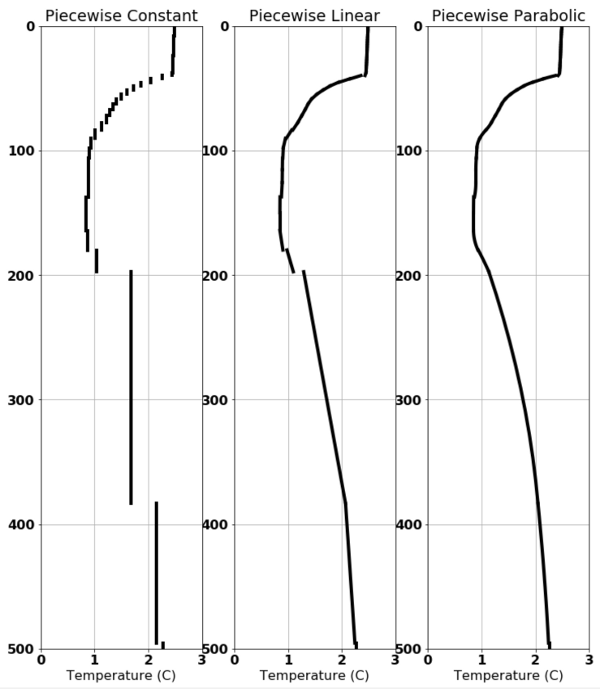
Before presenting this scheme, a quick review of polynomial reconstructions is in order. Some choices for the vertical representation of a finite volume quantity are shown here:
The algorithm has three phases: initialization, sorting, and flux calculation.
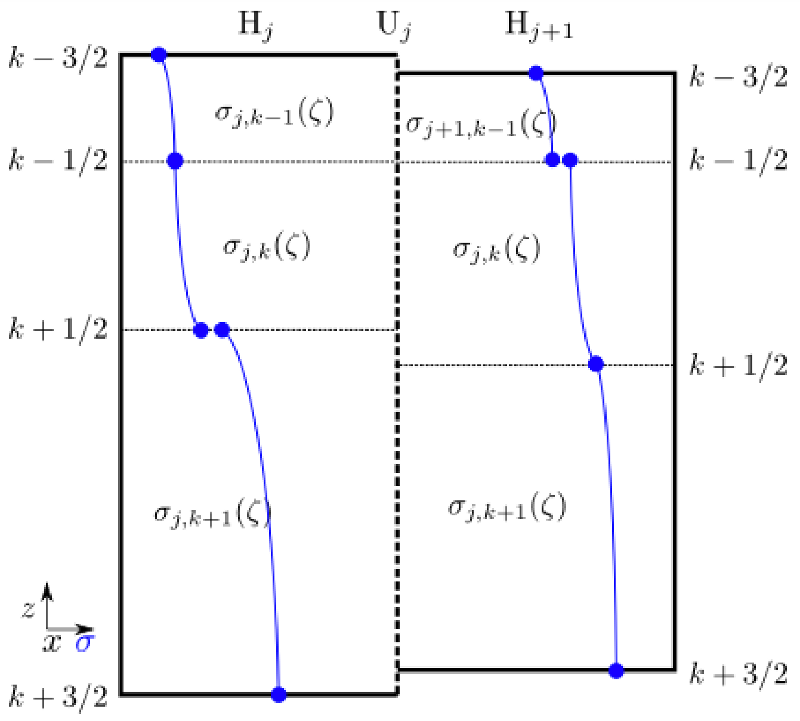
We begin by generating polynomial reconstructions of the vertical tracer quantities such as shown by the blue lines here:
Also during the initialization, the unstable parts of the water column are set aside to be skipped by this algorithm.
The epineutral surfaces have constant density, where we use this equation:
\[ \Delta \rho = \rho_1 - \rho_2 = \frac{\alpha_1 + \alpha_2}{2} (T_1 - T_2) + \frac{\beta_1 + \beta_2}{2} (S_1 - S_2) \]
When calculating \(\alpha\) and \(\beta\), there's more than one way to do it. Using a midpoint pressure gives neutral density while using a reference pressure gives isopycnal values.
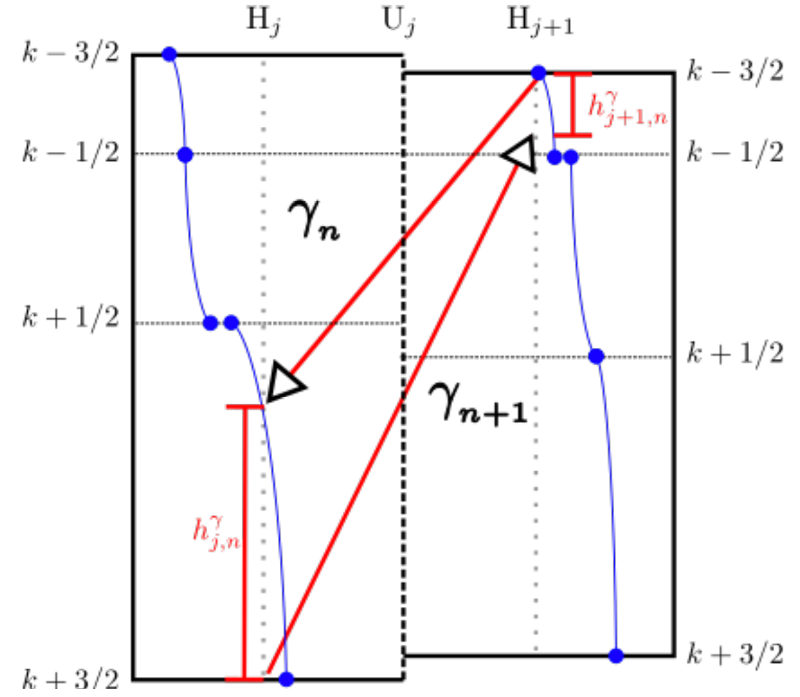
Given two adjacent water columns, we are going to be looking to match densities. The match does not need to be at the same level or even near each other in depth. Starting from the top two interfaces, search the column with the lighter surface water (second column) downward to find which layer contains water matching that of the first column at the surface:
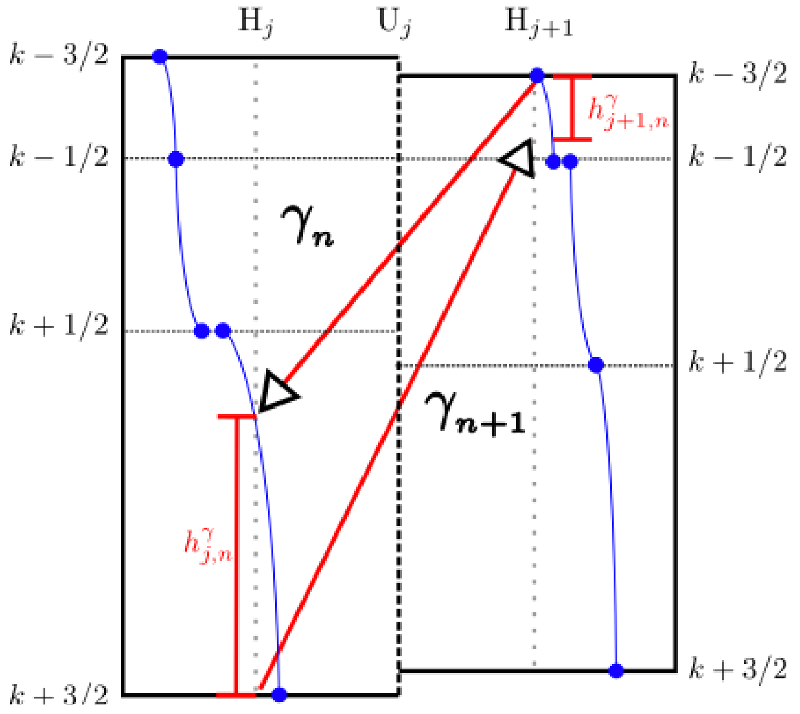
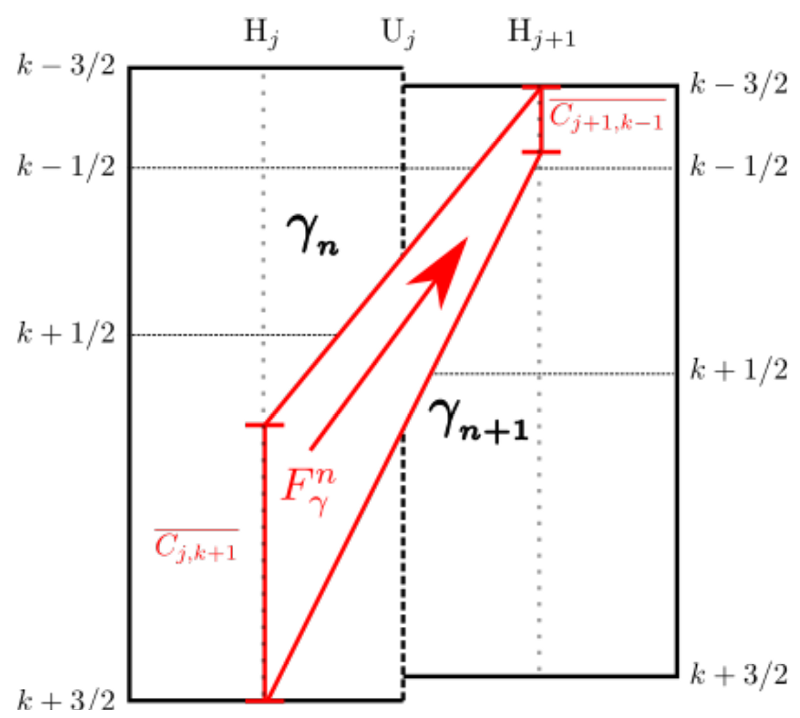
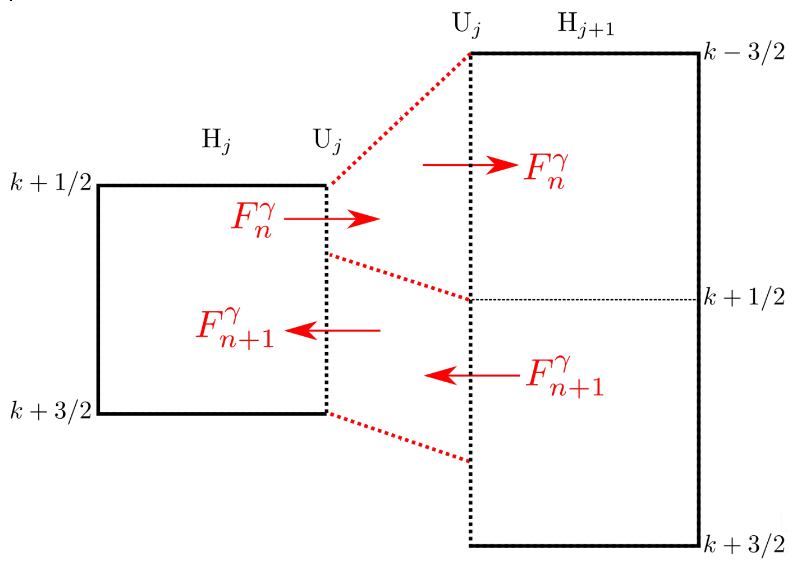
Once the location of the first column's surface density is found in the second column, one goes to the next interface below to find the bottom density of the water to be mixed. Then find that density within the first column. Iterate downward until no more matches are found. These pairs of surfaces make up what is known as a sublayer along which the diffusion can take place.
For each sublayer, the fluxes are based on the mean tracer quantities within that sublayer in each column. For a tracer \(C\), compute the vertical average of that tracer within the sublayer to form \(\overline{C}\). The flux can then be computed based on:
\[ F = K h_{\mbox{eff}} \frac{\overline{C_{j,k+1}} - \overline{C_{j+1,k-1}} }{\Delta x} \Delta t \]
where the effective thickness of the sublayer is:
\[ h_{\mbox{eff}} = \frac{2 h_{j,n}^\gamma h_{j,n+1}^\gamma}{h_{j,n}^\gamma + h_{j,n+1}^\gamma} \]
and as shown in this figure:
As shown in figure eddy_flux of the eddy fluxes, the diffusion in the surface boundary layer is assumed to be purely horizontal. A bulk scheme was explored but found wanting, so a layer-by-layer approach has been implemented instead. It is this layer-by-layer code which is described here.
For each water column, the boundary layer thickness is determined first. This can be either via the CVMIX boundary layer thickness or through some other means. Next, determine how many of the model layers are within this boundary layer thickness. It is common for neighboring cells to have differing numbers of layers within the surface boundary layer, such as shown here:
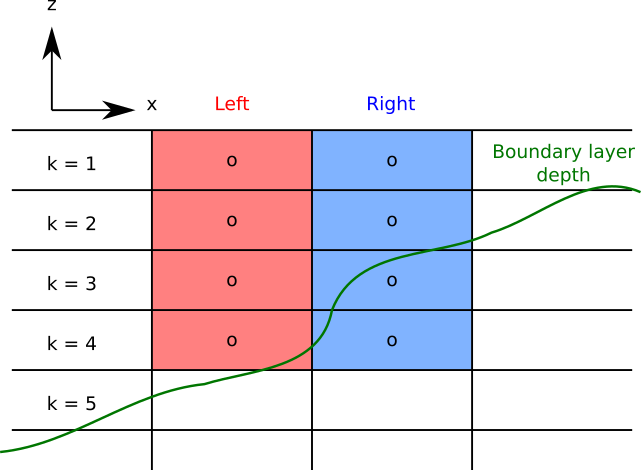
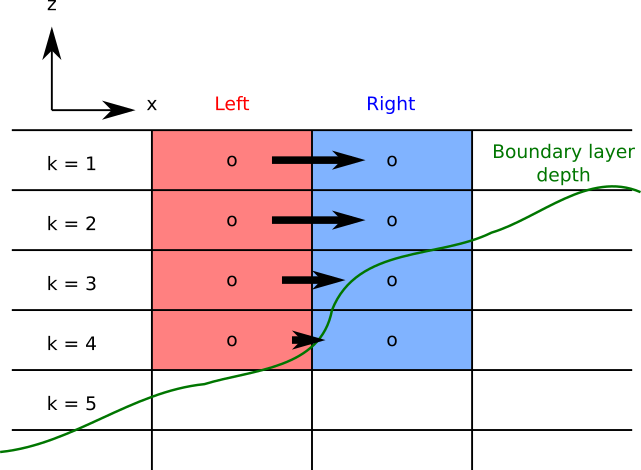
\[ F(k) = K h_{\mbox{eff}(k)} \left[ \phi_L(k) - \phi_R(k)\right] \]
where the effective thickness of the layer \(k\) is:
\[ h_{\mbox{eff}(k)} = \frac{2 h_{L}(k) h_{R}(k)} {h_{L}(k) + h_{R}(k)} \]
 1.8.13