|
MOM6
|


|
|
MOM6
|
|
Tracer Transport Equations
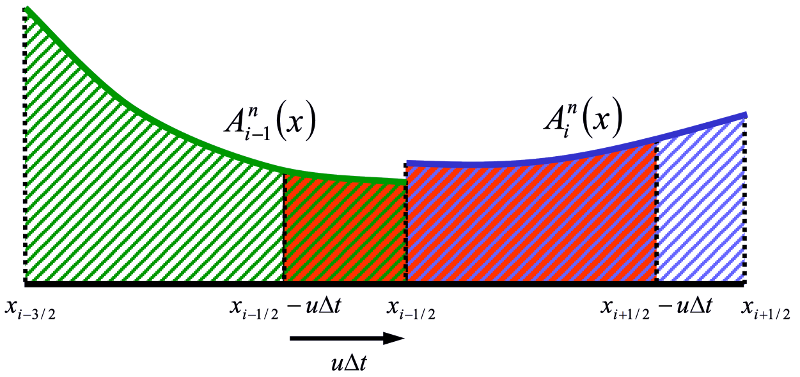
\begin{eqnarray} \int_{x_{i-1/2}}^{x_{i+1/2}} A_i^{n+1} (x) dx = \int_{x_{i-1/2 - u \Delta t}}^{x_{i+1/2-u\Delta t}} A_i^{n} (x) dx &= \mbox{} \\ \int_{x_{i-1/2}}^{x_{i+1/2}} A_i^{n} (x) dx - \int_{x_{i+1/2 - u \Delta t}}^{x_{i+1/2}} A_i^{n} (x) dx &+ \int_{x_{i-1/2 - u \Delta t}}^{x_{i-1/2}} A_i^{n} (x) dx \end{eqnarray}
Fluxes are found by analytically integrating the profile over the distance that is swept past the face within a timestep.
\[ a_i^n = \frac{1}{\Delta x} \int_{x_{i-1/2}}^{x_{i+1/2}} A_i^n(x) dx \]
\[ a_i^{n+1} = a_i^n - \frac{\Delta t}{\Delta x} (F_{i+1/2} - F_{i-1/2}) \]
\[ F_{i+1/2} = \frac{1}{\Delta t} \int_{x_{i+1/2 - u \Delta t}}^{x_{i+1/2}} A_i^n(x) dx \]
\[ F_{i-1/2} = \frac{1}{\Delta t} \int_{x_{i-1/2 - u \Delta t}}^{x_{i-1/2}} A_i^n(x) dx \]
With piecewise constant profiles, this approach give first order upwind advection. Higher order polynomials (e.g., parabolas) can give higher order accuracy.
Using "Easter's Pseudo-compressibility" (easter1993), we start with these basic equations for a tracer \(\psi\):
\[ \frac{\partial h}{\partial t} + \vec{\nabla} \cdot (\vec{u}h) = 0 \equiv \frac{\partial h}{\partial t} + \vec{\nabla} \cdot (\vec{U}) \]
\[ \frac{\partial}{\partial t} (h \psi) + \vec{\nabla} \cdot (\vec{U}\psi) = 0 \]
\[ \frac{\partial \psi}{\partial t} + \vec{u} \cdot \vec{\nabla} \psi = 0 \]
We discretize the first of these equations in space:
\[ \frac{\partial h}{\partial t} = \frac{1}{\Delta x} \left(U_{i-\frac{1}{2},j} - U_{i+\frac{1}{2},j} \right) + \frac{1}{\Delta y} \left(V_{i, j-\frac{1}{2}} - V_{i,j+\frac{1}{2}} \right) \]
Using our monotonic one-dimensional flux:
\[ F_{i+\frac{1}{2},j} (\psi) = U_{i+\frac{1}{2},j} \psi_{i+\frac{1}{2},j} \]
we come up with an estimate based only on an update in the \(x\) direction:
\[ \tilde{h}_{i,j} \tilde{\psi}_{i,j} = h^n_{i,j} \psi_{i,j} + \frac{\Delta t}{\Delta x} \left( F_{i-\frac{1}{2},j} (\psi^n) - F_{i+\frac{1}{2},j} (\psi^n) \right) \]
\[ \tilde{h}_{i,j} = h^n_{i,j} + \frac{\Delta t}{\Delta x} \left( U_{i-\frac{1}{2},j} - U_{i+\frac{1}{2},j} \right) \]
\[ \tilde{\psi}_{i,j} = \frac{\tilde{h}_{i,j} \tilde{\psi}_{i,j}}{\tilde{h}_{i,j}} \]
Next, we update in the \(y\) direction:
\[ h^{n+1}_{i,j} \psi^{n+1}_{i,j} = \tilde{h}_{i,j} \tilde{\psi}_{i,j} + \frac{\Delta t}{\Delta y} \left( G_{i,j-\frac{1}{2}} (\tilde{\psi}) - G_{i,j+\frac{1}{2}} (\tilde{\psi}) \right) \]
\[ h^{n+1}_{i,j} = \tilde{h}_{i,j} + \frac{\Delta t}{\Delta y} \left( V_{i,j-\frac{1}{2}} - V_{i,j+\frac{1}{2}} \right) \]
\[ \psi^{n+1}_{i,j} = \frac{h^{n+1}_{i,j} \psi^{n+1}_{i,j}}{h^{n+1}_{i,j}} \]
 1.8.13